Stratified city layout
First proposed in Syphilia, the stratified layout has been adopted throughout Groina in most large cities, with the notable exception of Erburgham, which follows a gridded layout. This simple system separates the citizens’ residencies by class, serving as a reminder of the hierarchy in place.
Design
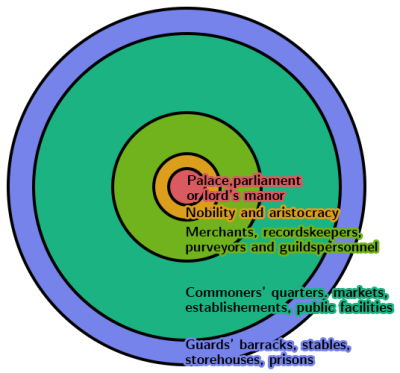
In the stratified layout, the most important people are always either at the highest or most central position of the city. This includes the king’s palace, lord’s manor or the house of parliament. It is often surrounded by the residences of private advisors or knights. Outside this guarded centre of the city lie the houses of the upper echelon. Nobility, aristocrats and landowners alike lived here in safety and cleanliness, as the core districts would be regularly patrolled by guards and groundskeepers.
These were followed by a large district of official houses and residences, those belonging to merchants and guilds, and anyone of sufficient wealth. Some of the more upper class shops would also be placed there.
The largest district in any city would be that of the commoners, which also included any public facilities, such as bathhouses, taverns, markets, workshops, schools, and community areas. Beyond the commoners’ district, you would find any barracks, training areas, stables and storehouses, and by the outermost wall, prisons.
The different districts are often separated by gardens or fences.
Functionality
A central road or roads would typically lead all the way across the city, from the gates to the palace, with possible checkpoints in between different districts.
Fresh water would be brought by aqueducts up to the well or water tower in the highest ranking area. Any wastewater, excluding sewage, from the royalty or ruling class would flow down to be used by the noble’s district. All the water is purified by passing it through smooth stones and sieves. The nobility’s excess flows down to the public well of the merchants’ district, and theirs down into the large water reserves of the commoners’ area.
All this water flows down to be used by the guards and whomever else resides in the outermost district, whose excess water, sewage and bathwater would be all mixed to be used as the drinking “water” in the prisons. An exception to this is in the city of Pierse in Linden, where all of the city’s combined sewage flows into the anus of former delegate Faros Gorink.